
Arzel Zoning
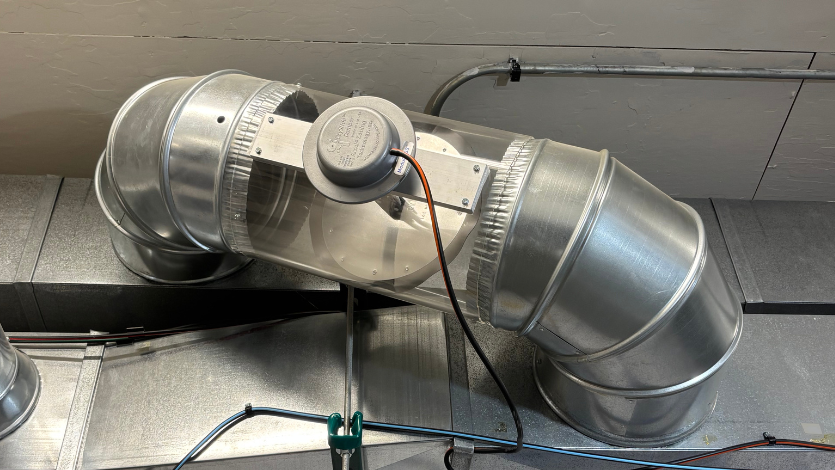
Static pressure is basically the air pressure inside the ductwork in an HVAC system. In zoning, we use static pressure as a functional tool. When dampers close to isolate only a portion of the ductwork, that zone gets more air, more velocity and more air movement. The thermostat will be satisfied faster, so the customer will be more comfortable.
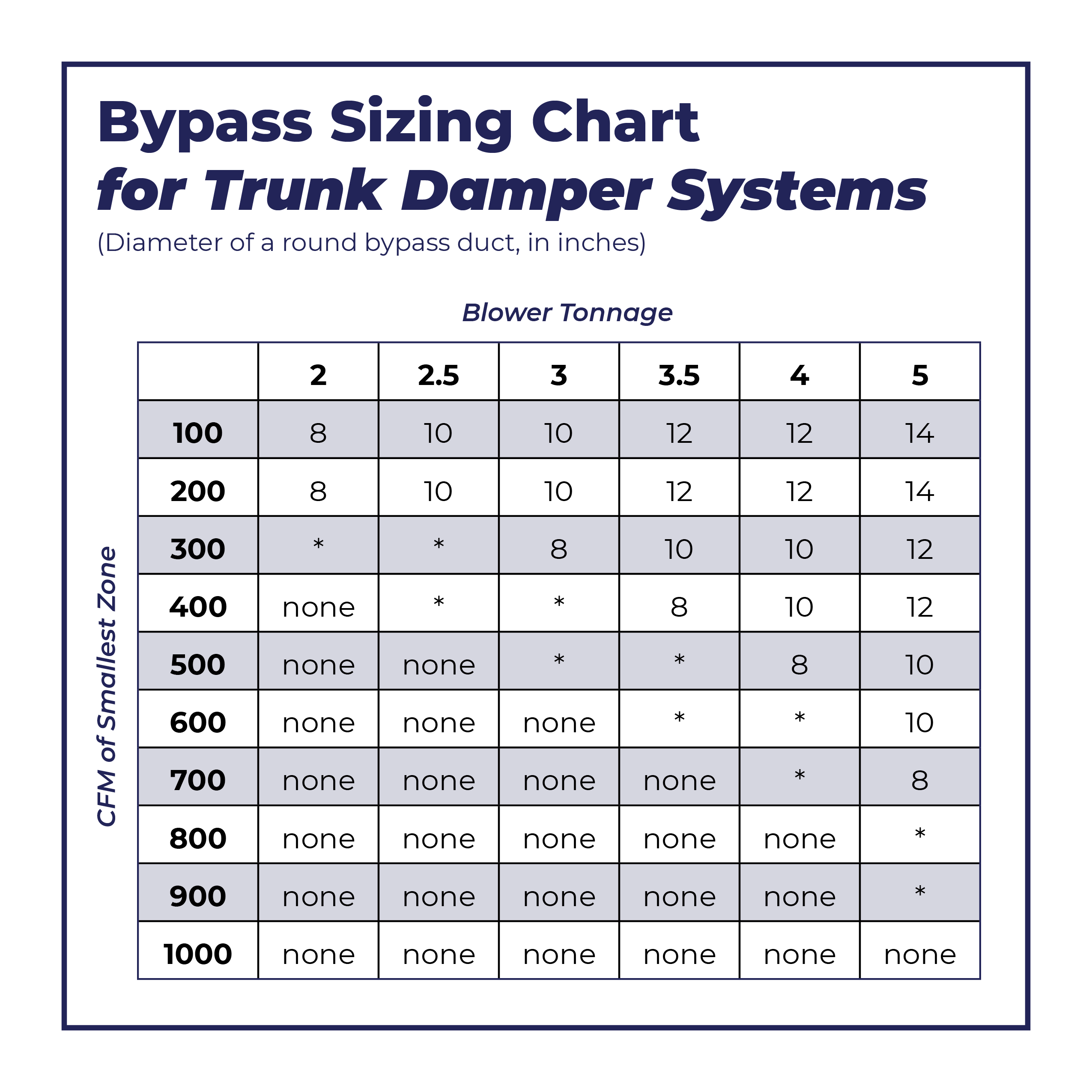
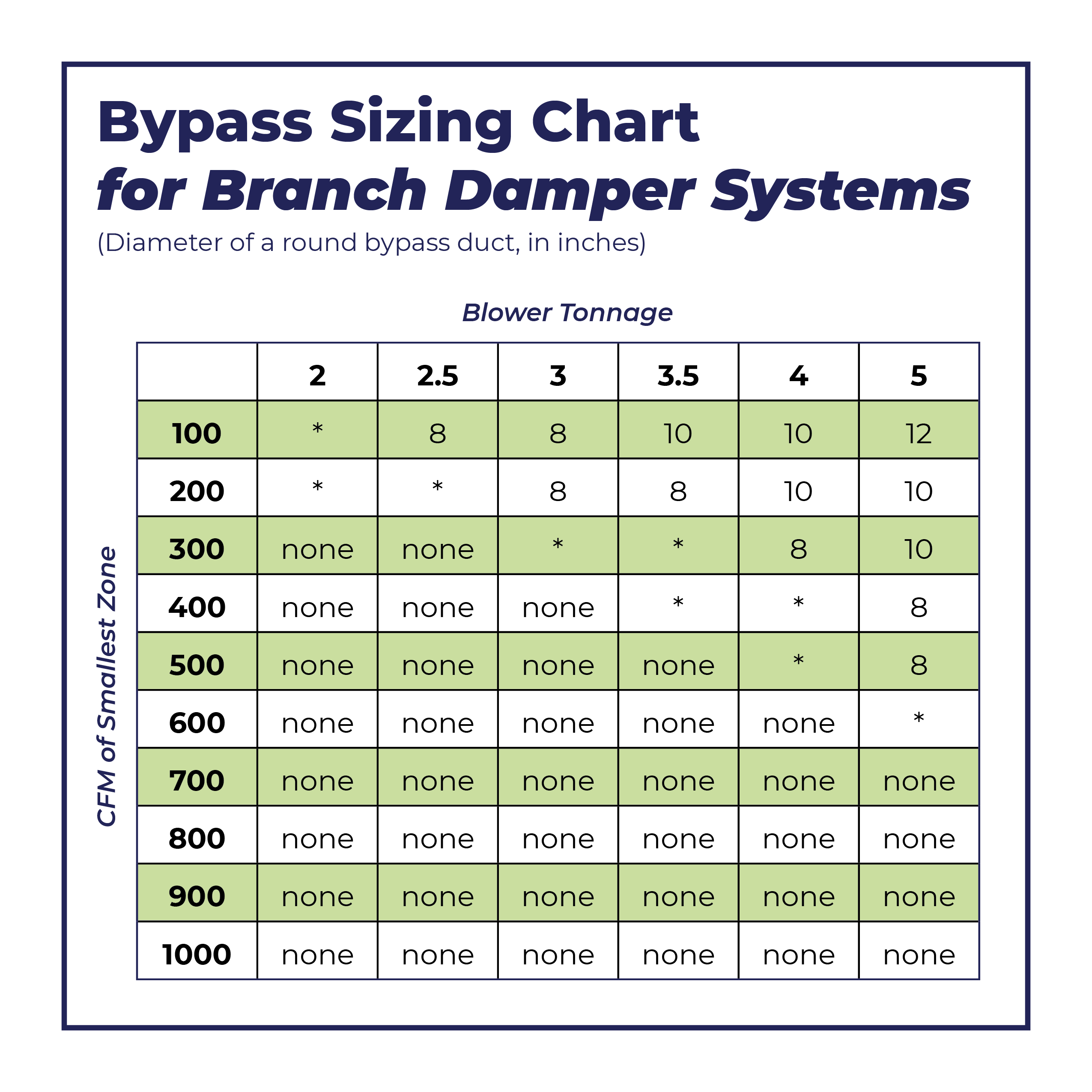
We recommend evaluating your zoning design against our bypass sizing chart to see how effective it is. The chart will tell you if you need a bypass to control static pressure. Many systems will not need bypass. If you do need a small bypass, that’s okay. But if you find that your system calls for a 12-inch or 14-inch bypass, take another look at your design. Consider what you can do to reduce the amount of bypass required.
To use the bypass sizing chart, first choose whether you have a trunk damper system or a branch damper system. A trunk damper system will usually have one damper for each zone, located in the trunk lines of the ductwork. A branch damper system has multiple dampers on each zone, one for each branch run that goes to that zone.
Next, find the design CFM of your smallest zone and the blower tonnage of your system. The number you see there is the diameter of the round bypass you’ll need, in inches. For applications with two-stage equipment where you’re using Arzel’s zone weighting, use the low-stage tonnage of your equipment.
You’ll notice that many sections of the chart say “none” because no bypass is required. If you see a star (*), then you have a borderline case. In these cases, our recommendation is to include the bypass on the job quote, but don’t install it at first. Commission the system without the bypass, and check to see if there is objectionable noise when the smallest zone is calling by itself. If there is objectionable air noise, you can install the bypass. If not, you can return the bypass parts.
A bypass is a duct that moves some air directly from the supply to the return, bypassing the normal path the air would take through the entire building. This relieves excess static pressure. A bypass damper will regulate the amount of air that bypasses the system.
Arzel’s ModuPASS® system monitors the pressure in the supply duct and opens a damper when the pressure reaches a threshold. ModuPASS is designed to work with ECM, variable speed, and constant torque motors.
Barometric bypass dampers also bypass air based on the pressure in the duct, but we only recommend these dampers for PSC motors. When barometric dampers are paired with ECM motors, the dampers have the potential to open and close too quickly, causing the blower to ramp up and down.
Find the diameter of your bypass duct on our Bypass Sizing Chart. If you’re in between sizes, choose the smaller size. The bypass damper will only open enough to relieve the excess static pressure.
Also, consider these special circumstances that can affect bypass duct size:
The root problem you’re solving with a bypass is that a zone is too small. If you can make that zone a little bigger, then the static pressure will return to an acceptable level. A bypass is the most common way to solve this problem, but there are sometimes other options.
One option is to use a slave zone like the Arzel Smart Zone. This type of zone does not have the ability to operate the equipment, but it does have its own thermostat and damper. A Smart Zone will only get conditioning when another zone is also calling. Since the zone never calls by itself, it’s no longer your smallest zone. You can do the bypass chart calculation with the next smallest zone. The Smart Zone is a good way to give occupants more control in a small zone, without having to install a bypass to compensate for the small zone size.
Another way to avoid using a bypass is to use wild runs. A wild run is a duct in a zoning system that doesn’t have a damper. Since there’s no damper, the wild run gets conditioning every time any other zone calls. Make sure the wild runs serve an area that can handle the over-conditioning. Sometimes this will be a laundry room or an unconditioned breezeway connecting a garage. You can add the CFM of the wild run to your smallest zone when you use the Bypass Sizing Chart, and it might be enough to avoid needing a bypass.
You can also avoid bypass by designing a dump zone. A dump zone is an area that gets extra conditioning whenever the static pressure gets too high. A dump zone is controlled by a bypass damper.
Zoning is safe for the equipment and effective for comfort as long as you follow these basic zoning guidelines:
Often, contractors still have questions about zoning and static pressure. For example, we’ve always been told that high static pressure is bad for ECM motors. But blower motor manufacturers don’t warn against zoning because it isn’t a problem for their motors.
The truth is, high static pressure is a problem if it’s caused by inadequate or insufficient ductwork. With zoning, we create higher static pressure on purpose to get the air where we need it. It’s not happening all the time.
One of the reasons higher static pressure is not a problem in Arzel systems is that our dampers are already open when the blower starts. The dampers close slowly to avoid stressing the blower motor. At the end of the call, all of the dampers open again, allowing proper cooldown for the motor. This is just one of the ways we protect equipment while helping you get the most out of it.
If you have further questions, please give us a call. We’re happy to discuss how zoning works and how you can design an effective and safe zoning system.
You usually won’t need a bypass if the smallest zone is at least 35% of your ductwork. If you’re using Arzel’s zone weighting with multi-stage equipment, the smallest zone can be 25% of your ductwork. Check our bypass sizing chart to see if you need a bypass.
The size of the bypass you need depends on the CFM of your smallest zone and the blower tonnage of your equipment. Use our bypass sizing chart to determine what size you’ll need.
Place the bypass at least 8 feet from the return. If possible, place it at least 8 feet from the supply as well. This will prevent the conditioned air from causing the equipment to overheat or freeze.
As long as you follow basic guidelines to design the zoning system, the static pressure will not damage the blower motor. To alleviate any risk, Arzel Zoning systems open all dampers before the blower starts, then slowly close dampers. At the end of the run cycle, all dampers open again.
You just need to know the basics of static pressure to install zoning. If you notice any objectionable air noise when the smallest zone is calling alone, then you’ll want to install a bypass or create a dump zone.
Written by
Ken Barton, VP of Technical
Nick Seifert, Engineer
Erika Popp, Marketing

There are three main steps to installing a Pro Panel zone control system: Install the dampers and tubing. Install the panel and thermostats. Connect to the Arzel Pro app to configure the Pro Panel for your installation. After you complete these three steps, your customer will feel the difference immediately. This is one of our […]

Our new Pro Panel control can zone up to 16 zones. That’s twice as many as our biggest AirBoss, and four times what our HeatPumPro can do. With 16 zones possible, the Pro Panel can be a zoning solution for more light commercial buildings and large houses. On top of the additional zones that are […]

The Arzel Pro Panel app gives contractors more control, easier setup, and better troubleshooting capabilities. All of that comes in a no-nonsense package. The app is simple to connect and doesn’t require Wi-Fi or cell service. We’re proud that the Arzel Pro app makes the Pro Panel our most customizable panel. And it’s still easy […]

App-controlled HVAC zoning panel is feature-rich and highly customizable; pairs with trusted Arzel dampers Cleveland, OH (Feb. 10, 2026) – Arzel Zoning Technology, a trusted name in HVAC since 1983, is proud to announce a new zoning control: The Pro Panel™. This universal zoning control offers advanced control and a feature rich system, all with […]